digital making (2010)
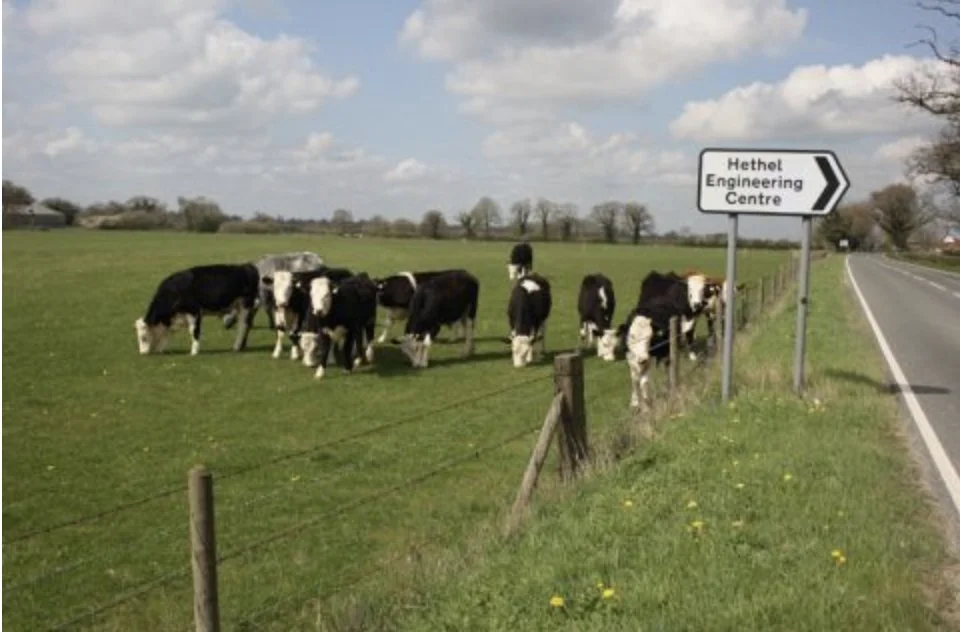
Location, location, location (2010)
The digital making blog was started when I became resident artist at Hethel Engineering Centre in April 2010 with almost weekly posts about conversations, explorations and reflections. It also covers some of the exhibitions / events / conversations that followed up to March 2011.
digital making was supported by The National Lottery through Arts Council England, Hethel Engineering Centre, Norfolk County Council, Sir Philip Reckitt Educational Trust and SCAN
The original blog was published on the a-n (The Artists Information Company) website, this version is largely the same. Some of the image files need to be located, so screen-grabs have been used where necessary as an interim measure. Corrections for spelling and grammar have been made and some pieces of text edited for readability and relevance.
14 April 2010
Meetings and start dates
The project started on Monday with a meeting in London. Discussing the conceptual basis of the project, ideas about exhibition venues and research papers with Helen Sloan from SCAN was a great way to kick things off. The conversation flowed as I emptied my brain about all the connections, connotations and relationships between the residency focus and my research. Helen put forward ideas and contexts for me to consider. It was a good start to the project.
Tuesday found me at a meeting at Hethel Engineering Centre. Derek Hillyard the engineering manager has been supportive of my project ideas from the outset, responding to my first email enquiry by inviting me to a meeting to discuss my ideas. With the project up and running its all systems go and we discussed logistics such as days to be on site, ordering software, publicity and Derek also suggested a visit to a local foundry that use RP which sounds great. I’m feeling excited about getting started on documenting this new type of industrial space over the next two weeks before I begin my CAD training.
Of course the project didn’t really start on Monday, it’s a culmination of ideas gathered from a whole host of sources, interactions, exhibition visits, conversations, reading and research all of which has been piling up over an extended period of time. These ideas are beginning to be filtered and organised, selected and refined which is a very welcome process. I have wanted to do this residency for a long time.
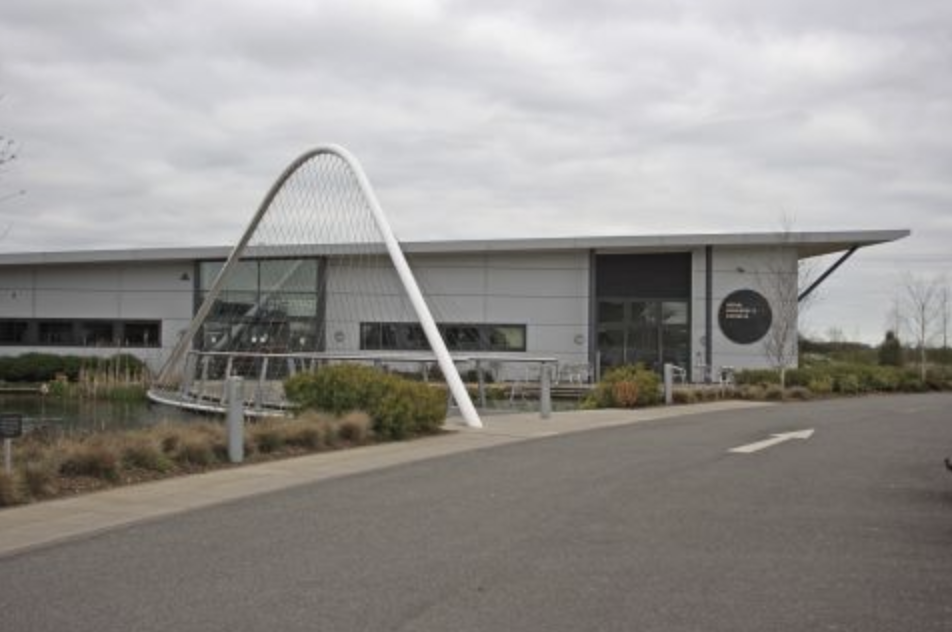
New Industrial Space (2010)
21 April 2010
Site visit
The intention of the site visit today was to document the architecture of the building. Focusing on only the exterior I became interested in how the landscape is reflected in the materials used.
The Hethel building sits in a large plot, with fields on 3 sides and a road to the front. There are other buildings around but some distance away, Lotus Cars, farms and a few houses are its closest neighbors. It’s a total contrast to the industrial scenes depicted in Lowery’s paintings, where buildings are packed together and people stream towards a factory entrance at the beginning of the working day.
I’m considering the ideas of new industrial space which I have been reading about in Manuel Castells book The Rise of the Network Society. He discusses the changes that have occurred in manufacturing through the integration of new technologies. I’m thinking Hethel is a new type of industrial space and ask myself when did engineering make the transition to using digital technologies?
Outside looking in (2010)
22 April 2010
Work-pages started
I document my research and practice process meticulously using work-pages which are usually compiled into workbooks but also available as individual pages. I hand draw each page using traditional copying materials. I’m exploring ideas of editioning these books and if there should be one hand drawn master version with the rest being prints (photocopies) or if they should all be hand drawn.

Work-pages (2010)
4 May 2010
A line has three things: 2 end points and the line itself
This was my first day learning Computer Aided Design which I have never done before. Derek, the engineering manager was teaching me alongside Paul, a tenant at Hethel. It’s seems a complex programme, as they all do, until you get the hang of them. However I find I don’t visualise in 3 dimensions in the way engineers and designers do and so need a fair bit of help. Derek is asking me to consider my design intention, which I am considering could be a variation on a creative intention but in this context means making everything intentional. I’m not sure if there is a place for the accidental/unintended here as there is in art practice. The objects I made in CAD were rather small due to my brain working in cm and the programme working in mm – which I suppose was me trying to be intentional and still making mistakes.
There is a whole new vocabulary with this software and the engineering approach which is really interesting and is making me think about all kind of things in new ways. There are words and phrases which take me back to secondary school maths and technical drawing classes (some 20 years back) and some which are completely new to me…. tangents, adding relations forces conditions onto lines, features, extrude Boss/Base, referencing the origin, restraints, planes and surfaces…. Best piece of vocabulary from the day was from Derek, ‘infinite thinness’ describing something which had well …..infinite thinness.
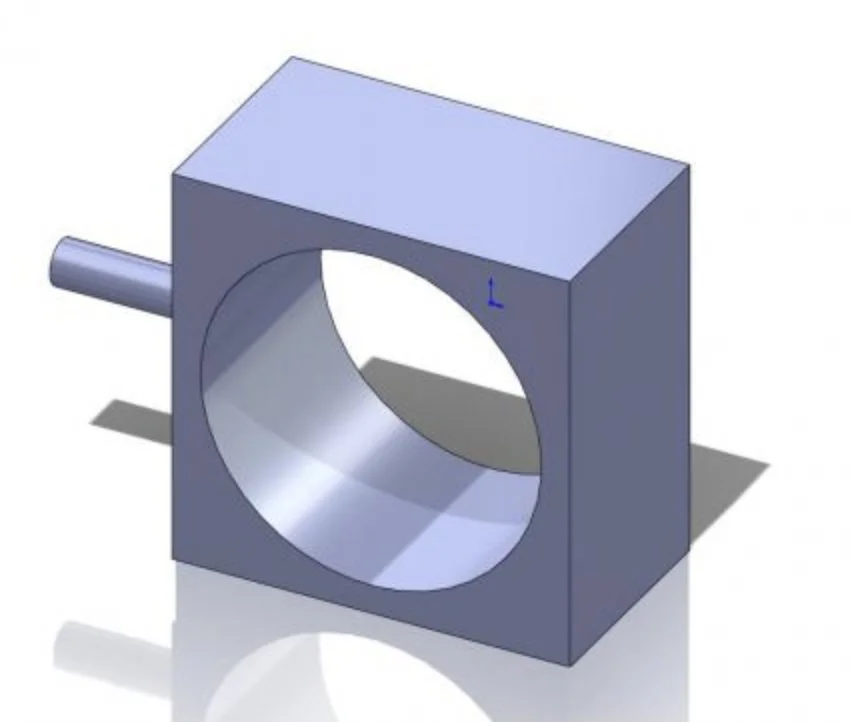
Square, Circle, Cylinder: CAD Drawing. (2010)
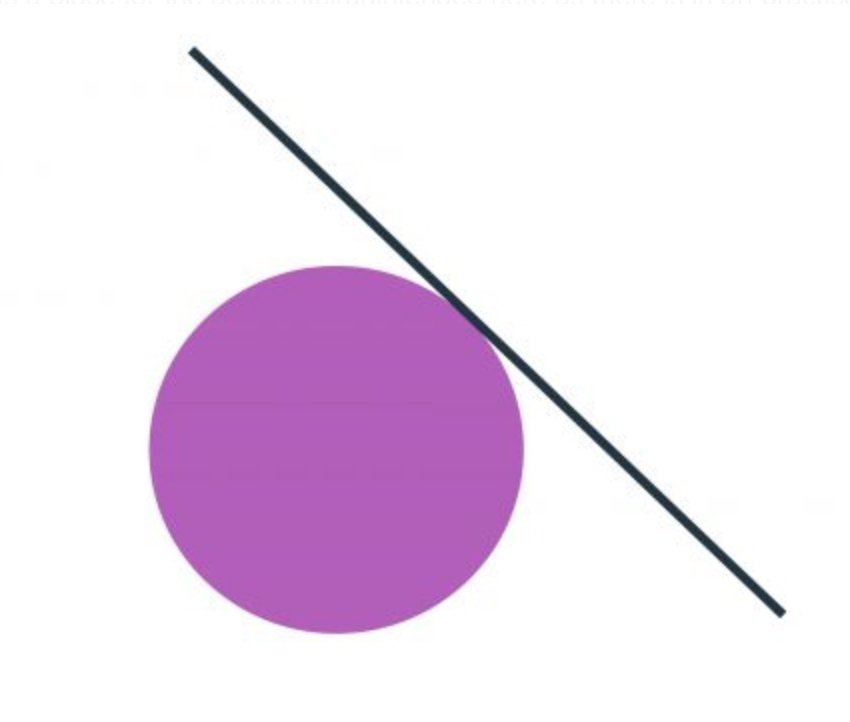
Tangent (2010)
10 May 2010
After the challenges of learning the beginnings of CAD, at the end of last week I was back in my comfort zone taking photographs. This time of the inside of the building focusing on a number of spaces which are for hire including conference, meeting and training rooms.
I’m back learning CAD tomorrow and have looked over my erratic and nonsensical notes. I’m hoping when faced with the program I will remember what we learnt last week, I seem to remember it all starts with ‘starting a sketch’.
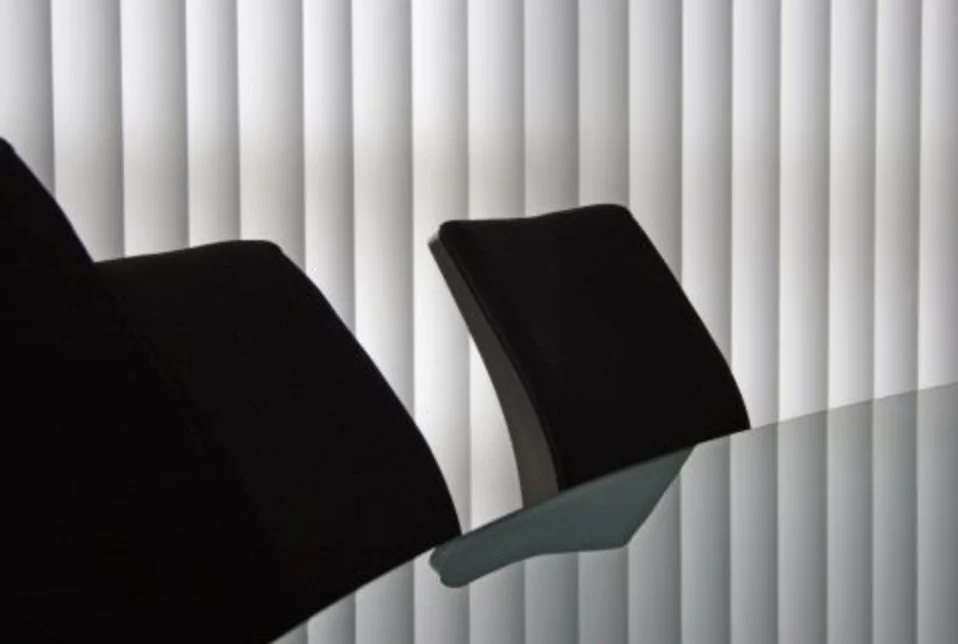
The Glass Room (2010)
11 May 2010
Over engineered
Today when faced with the CAD programme I did remember quite a bit from last week (when it felt a totally alien way of working). Today I was able to complete the tasks that Derek set Paul and I, and it felt a bit more familiar and accessible.
We had discussions about the Falkirk Wheel which Derek thought was an excellent example of the cross over between engineering and art and yes it is an impressive piece of architectural design although I haven’t seen it in action, only photos. The Millennium Bridge in Newcastle near Baltic also featured in our discussions as did the Grand Canyon Skywalk – I can hardly even watch the video on the website without feeling queasy. We moved onto how some structures (and maybe objects also) can be over engineered, possibly the Forth Rail Bridge being an example of this, we thought perhaps because the first Forth Rail Bridge collapsed after construction.
When I started thinking about CAD and Rapid Prototyping (RP) and wanting to be at Hethel, it was the combination of both learning CAD to make a ‘no pointed needle’ in RP and to document this new industrial space environment that was important. The no pointed needle came from a video work I made in 2003, Video Triptych. The work used a real object, manipulated to camera and captured to tape using different camera functions: the result is the no pointed needle which only exists digitally. My aim is to make this object three dimensional (in its new form) using CAD as a translation tool and RP as the making tool. I tired to make the no pointed needle and a needle in CAD today with some success (and help). In CAD the needle becomes an object constructed of parts rather than drawn from a single length of wire which is how needles are manufactured.
Quote for the day, well there are two, something being over engineered (but my work being described as under engineered!) and also ‘a straight line is an arc of infinite radius’. There was some discussion between Paul and Derek as to the meaning of this but I hadn’t a clue what they were talking about. I imagine that if I launched into art-speak there might be a similar reaction. I like how each job/profession has its own language and how that translates across different disciplines (or not) – all a learning curve or arc perhaps.
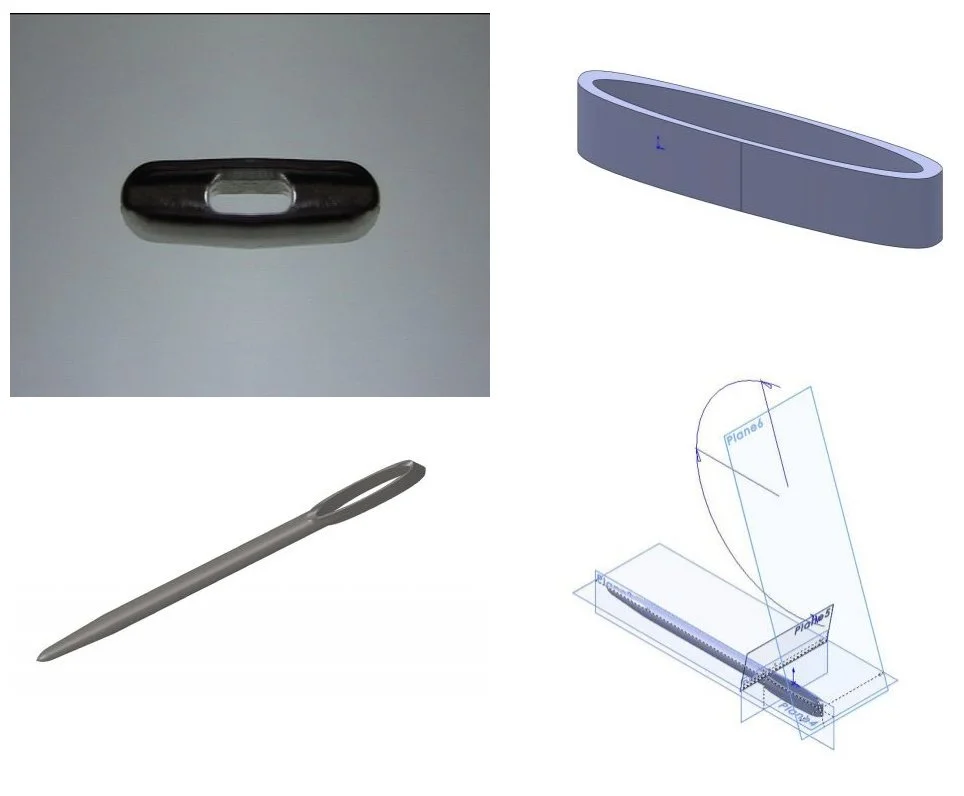
Top left: Video Triptych The No Pointed Needle, Top right: No Pointed Needle First Attempt, Bottom left: A Needle of Sorts, Bottom right: It’s more complicated than it looks and it looks complicated (All 2010)
13 May 2010
Research in temperature controlled rooms and a society meeting
Went to Tate archive yesterday to look at some Artist Placement Group (APG) documents. These archives are odd places to visit, everyone seems to speak in hushed tones, but then the door from the archive into the reading room is incredibly noisy each time it is used it bangs shut. I don’t think the staff hear it any more. I been to quite a few archives and I am always excited before I go at the thought of what I might find, sleepy when I am there due to the subdued lighting, the constant temperature and the almost (!) silence, and then hopefully buzzing with thoughts a day or so later.
The archive took most of the day and then off to the Science Museum to have a quick look around (where I was thinking about what defines a designer and what an engineer). It was only a quick look as I went to the Newcome Society lecture, The History of Computing by Professor Martin Campbell-Kelly. The lecture came to my attention through one of those evenings of ‘focused Internet research’ which quickly turns into a trawl through lots of ‘interesting stuff’ I would never have found before the days of the internet. How exactly the internet has altered the ideas of serendipity I don’t know. There were some good images and diagrams of early offices in the lecture which was what I wanted to know more about: Why did people document, through painting and etching and later photography the work place? More focused research, well browsing really, of the Science and Society Picture Library and found a rather nice example of office life as it was: Office Life: Headquarters of Clarks Shoes
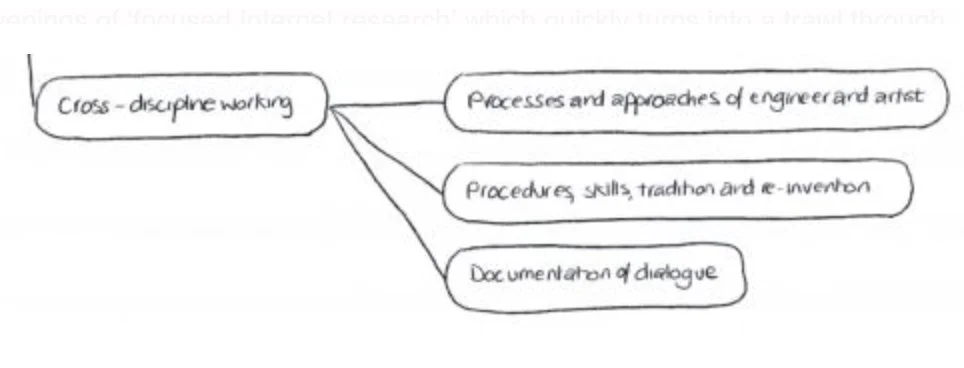
Project mapping - detail (2010)
22 May 2010
Engineering workshop and bridge talk
I started to document Derek’s / the engineering workshop last week where there are mills and lathes – some old some very new. We discussed the transition from traditional towards computer operated processes and the shift from skills to knowledge. The physical manifestation of knowledge is skill, where materials and tools are physically manipulated to create objects. So in terms of what’s happening in contemporary engineering (as in many professions) is the integration of the digital. Knowledge develops in terms of using software’s to create the design work. The work has become more procedural in terms of operating the new Computer Numerically Controlled (CNC) machines. Where as a lathe operator would load the material and use skill to achieve the object, with the CNC machines there could, (especially in larger companies) be a loader – who puts the material into the machine, the setter who loads the information into the computer integrated into the machine, and the programmer who writes the design in computer code which the setter inputs. With CNC processes you can walk away while the part is being tooled (made), obviously differing from traditional lathe work. There are varying degrees of skill in these (CNC) processes, in some smaller companies all the processes could be carried out by one individual. This segmenting reminds me of Adam Smith’s division of labour and Derek talked about the shift from blue collar to white collar which I have explored extensively in my practice.
We also discussed contemporary architecture and how the architect needs to have a working awareness of the capabilities of engineering as that is essentially what will make the building stay standing. Having said that, Derek was saying that engineers thrive on a challenge and that’s what we have with this no pointed needle. Working from a video still is problematic (and then also an opportunity) as it has no three dimensional measurements. So the measurements loaded into CAD come from estimation which I image is poor engineering practice. But from an artists perspective estimation and aesthetics is something I often work with. We will get there in the end (get the no pointed needle made) but it’s interesting to consider where the end actually is in art practice. The process of identifying when something is finished is more fluid for artists as work can always be described as being ‘in process’ with the presentation of the work in exhibitions or artists talks acting as a end point, at that moment in time. However as one body of work is presented the things that didn’t quite work or those interesting ideas that started to emerge are the staring point for the next body of work. It’s a constant evolving process, at least it is for me.
I’m wondering if the CAD drawing/design of the no pointed needle will become more interesting to me and I could leave the video still image behind (using it as a departure point only). For an engineer that would be more difficult because from what I’m learning its about finding the solution to the original brief. Paul, the other CAD student himself an engineer, suggested with humour that to abandon the original intention (the translation of the video source material) would be bodging. Art practice as bodging sounds an interesting idea to me.
I left Derek last week with my Shire Library of How needles are made and in return I was lent a book about the Forth Bridge which I read the other night. We wondered last week if the over-engineering of this bridge was due to the first one collapsing during construction but it was in fact another, the Tay bridge, which collapsed after construction. There was also mention of the Forster + Partners Millau viaduct in France.
That’s what is so good about residencies, the original aims are explored but it’s all the other subjects and ideas that come alongside that makes it such an interesting way of working.
All this and not so much about the CAD and RP stuff we did, so more about that later.
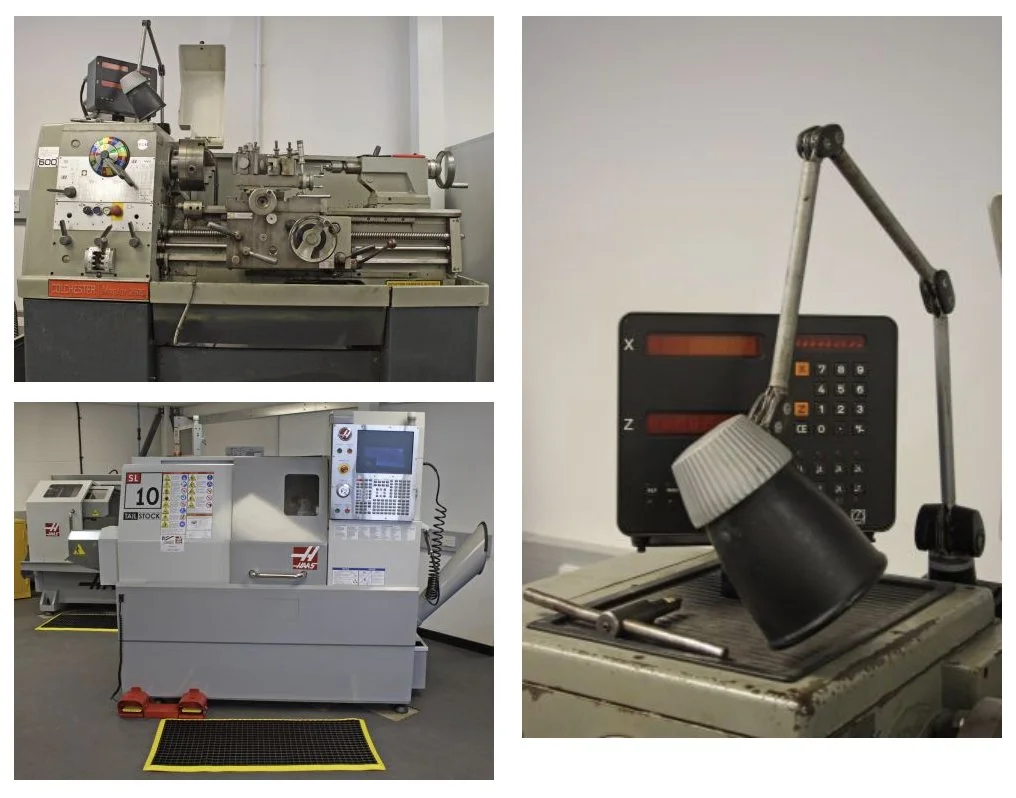
Top left: Colchester Master 2500, Bottom Left: CNC Lathe, Right: Control panel (All 2010)